OODA
The so-called OODA-“Loop” was originally a theory of the decision process a fighter pilot goes through, developed by John Boyd. This was later turned into a general theory of decision-making and conflict. OODA is an acronym for the the four phases of this decision cycle:
- Observe: Information gathering
- Orient: Analysis and interpretation of the gathered material
- Decide: Deciding on a course of action
- Act: Execution of the decision
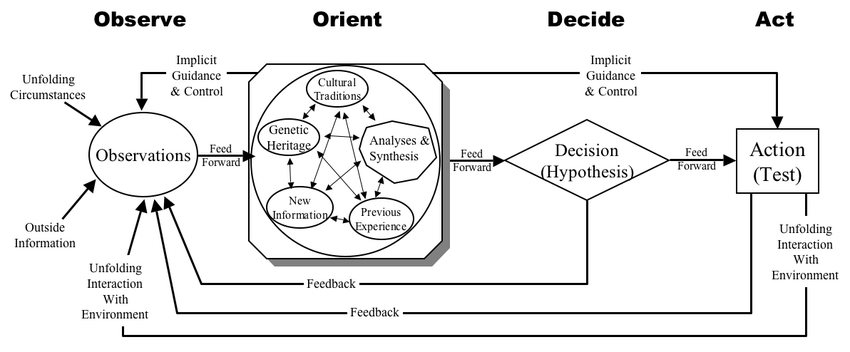
The key idea would be to continously cycle through the four phases of the “loop”, updating both understanding and actions in real time. If you go through this loop “faster” than your enemy, you’d be able to disrupt their decision-making and thereby gain an advantage over them. It is important to note that this is not about absolute speed though and more about the ability to adequately observe and interpret and adapt to an ever changing environment and your enemy.
The four “phases”
We should note that it can be a bit misleading to speak of “phases” of a “loop”, since according to Boyd all the moments of this cycle are active at the same time. So this isn’t something you walk through sequentially. Boyd makes this explicit when speaking of orientation:
the entire ‘loop’ (not just orientation) is an ongoing many-sided implicit cross-referencing process of projection, empathy, correlation, and rejection (Boyd 1995)
Observation
In the observation phase the actor / the system gathers information on their environment, their own position in this environment, and of course those of the enemy. It’s important to note that this isn’t a passive activity, but highly active: often you’ll have to actively seek out information, decide what you pay attention to. It’s also important to note that “more data” doesn’t automatically guarantee better results.
Orientation
During the orientation phase all the information that has been gathered is now being interpreted. That is, meaning is created, threats and opportunities are identified. And with this is produced a range of possible options.
According to Boyd the orientation phase is the most important phase of the “loop”, since it enacts an “implicit guidance and control” (Boyd 1995) on the observation-, decision- and action-phase. So, already our initial observation will be guided by our implicit and explicit analytical frameworks.
Updating your analytical framework
The analytical framework with which you interpret the world isn’t and probably also shouldn’t be fixed. It should be continously updated. Boyd distinguishes two processes during the orientation phase, analysis & synthesis (elsewhere described as Destruction and Creation):
analysis (understanding the observations in the context of pre-existing patterns of knowledge) and synthesis (creating new patterns of knowledge when existing patterns do not permit the understanding needed to cope with novel circumstances) (Boyd 1995)
This insight into the need to continously update our mental models is based on his interpretation of the second law of thermodynamics and the principle of entropy. Our internal models are closed systems and are thereby subject to increasing entropy, insofar as the divergence between the outer world and our inner model of this world grows.
Boyd is skeptical when it comes to our ability to simply update existing frameworks:
any inward-oriented and continued effort to improve the match-up of concept with observed reality will only increase the degree of mismatch. (Boyd 1987)
People using theories or systems evolved from a variety of information will find it increasingly difficult and ultimately impossible to interact with and comprehend phenomena or systems that move increasingly beyond and away from that variety - that is, they will become more and more isolated from that which they are trying to observe or deal with, unless they exploit the new variety to modify their theories/systems or create new theories/systems. (Boyd 1992)
Basically, minor adjustments to our frameworks would just further increase entropy. Instead Boyd suggests to dismantle existing interpretative frameworks and create new ones from the fragments: an ongoing process of Destruction and Creation.
Dangers
There’s an inherent danger if your orientation enacts to strong guidance. As we’ve seen, the observation phase is never neutral:
The most dangerous internal state of an OODA ‘loop’ occurs when the orientation process becomes so powerful that it force fits the organism’s observations into fitting a preconceived template, even when those observations threaten the relevance of that template. (Spinney 2005)
This would be a situation where you are either blinded by your ideology, or maybe even coming to believe your own propaganda, that you’re no longer able to properly perceive reality.
See also: Orientation
Decision
The actor / system commits themselves to one of the options identified / produced during the orientation phase.
Action
The decided-on action is taken.
Conflict
Conflict between two actors is basically a conflict between two OODA loops. The most evolutionary and effective loop wins.
you can either go through the OODA “loop” cycle faster than your opponent or you can vary your tempos and rhythms so your opponent cannot keep up with you (Hammond)
You can also intervene in your enemies OODA loop, slowing them down or rather disrupting their ability to properly process reality.
Disrupting the enemies’ observation phase
This is everything that poisons the observational “input”.
- Misinformation / Disinformation: the creation of wrong or contradictory data
- Deception with patterns, for example, creating predictable patterns, only to suddenly break them, causing irritation
- Masking real movements, for example via [[ noise ]], diversions.
Disrupting the enemies’ orientation phase
Everything that hurts our sensemaking capabilities.
- Creating ambiguity and uncertainty
- Reshaping the environment faster than the enemy can (re-)frame, comprehend and adapt to it
- utilizing cognitive biases, forcing the enemy to interpret data through obsolete models.
Source
- Boyd, J. (1995). The Essence of Winning and Losing
- Boyd, J. (1992). The Conceptual Spiral
- Boyd, J. (1987). Destruction and Creation
- Spinney, C. (2005). Is America Inside Its Own OODA Loop?